




By Jordan Roberts
John Locke Foundation
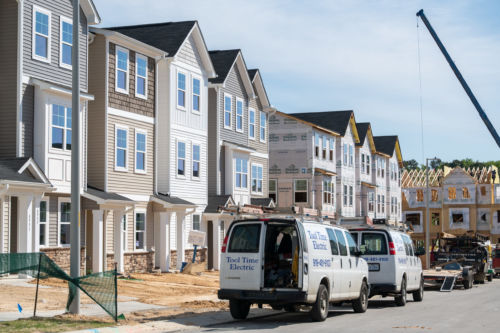
The American dream of owning a home is falling out of reach for many in our state. Home prices continue to rise in North Carolina as we lag pre-recession levels of new construction. Simultaneously, our state welcomed over 100,000 new residents just last year. Both current residents and newcomers to North Carolina will face hardships in affording starter homes or upgrading homes as family needs change, unless reform happens. That reform needs to focus on allowing more homes, and homes of a different variety, to be built.
A review of available data illustrates the case for why we need to build more homes. It also provides a cautionary tale of how other states have failed in this policy area. Lawmakers and local leaders can look to California to see the fate of a state that doesn’t allow supply to match demand. Our state is in a similar position to California’s a few decades ago: steady economic growth and a mass influx of new residents. After years of failing to allow enough housing to be built, California’s housing market has priced out many of its residents, who are now fleeing to lower-cost states.
A recently released paper by Dr. Michael Tanner of the CATO Institute illustrates some parallels between where North Carolina’s housing market is now and where California’s was before it went out of control. Dr. Tanner found many troubling trends in North Carolina’s housing market in the paper. For example, North Carolina will need 900,000 new homes over the next decade to meet projected demand. Furthermore, vacancy rates for homes and apartments have fallen steadily since 2010, further illustrating the point of low supply. Lastly, the inflation-adjusted price of homes is up more than 30% since 2010, while rents have grown by more than 14%. All in all, supply is down, and prices are rising.
What can we do?
This debate of what to do manifests itself on two fronts. First, within local communities: some who wish to prohibit new development or different types of homes are pitted against those who see the need for more housing and density built. Similarly, you have a broader debate about whether localities or the state government in Raleigh should determine zoning and land-use policies.
To address the latter first, North Carolina is a Dillon Rule state, which means, in most circumstances, municipalities get their authority delegated to them by Raleigh. Whether or not that is the proper arrangement between the state and localities is a debate for another day. The General Assembly can rein in most of the power it delegates to municipalities for governance, just like the arrangement between the legislature and the executive agencies whose authority is also delegated by the General Assembly.
On the former, upward mobility and homeownership should be shared goals of all residents of a community. Not every individual or family will always opt for homeownership. Still, we should be promoting markets that are conducive to a high supply of homes and housing that meets the individual needs of families and residents. Housing and homeownership have serious implications for economic growth and individual prosperity, so we should encourage policies that allow developers to meet the community’s needs.
Many municipalities have taken steps on their own to reform zoning. This is good and should continue as cities and towns grapple with a population increase. However, Raleigh can set a statewide policy for how zoning, permitting, and plan approval should happen at the local level.
A good blueprint for the types of reforms that could happen appeared in a Senate bill from 2021, Senate Bill 349. This piece of legislation was a proposed statewide zoning policy that would have significantly reformed the regulations allowing different types of homes to be built on residential property. The bill would legalize “middle housing” — defined as duplexes, triplexes, quadplexes, and townhomes — on all land zoned for residential use. Further, the bill would have allowed homeowners to build and rent accessory dwelling units (ADUs). Lastly, the bill had provisions that better balanced the scales between property owners and local governments. All are worthwhile reforms that will alleviate pressure on housing supply and boost property rights.
Zoning reform is based on free-market principles. Limiting the types of homes that can be built threatens the economic prosperity of North Carolinians and the continued growth of our state. It skews the market towards specific types of houses that may be out of reach for many looking to become homeowners. To combat this, lawmakers in Raleigh should look for ways to reform local zoning regulations and direct municipalities to limit delays in getting construction finished. To continue to grow as a state, we must have the housing inventory to keep up with demand to avoid the fate of California. Simply put: we need to build more houses.
Subscribe to get the latest posts sent to your email.

Comments are closed.










Author is insane. We moved to Joco because Wake county is awful. Urbanization is a key component of its awfulness. The infrastructure strains, the crime, the social and political influxes are damaging. I propose a county wide mandate: No lots less than 1 acre from here on out, and houses must be separated laterally by at least 75 feet. Look at where most of the crime is in Clayton, Cobblestone area and it’s DENSE.
@Brett: More government rules and restrictions is NEVER the right answer. There’s already too many restrictions on what I can and cannot build on my OWN PROPERTY. The *REAL* solution is to get rid of the RINOs in the NC Leg that continually stop municipalities from charging impact fees on developers (that would pay for infrastructure needs). Until we VOTE OUT ALL INCUMBENTS and get representatives that actually represent THE PEOPLE, nothing will change. Unfortunately, most JoCo voters (82% last election) simply vote along the party line, ensuring that things stay the same. #VoteOutIncumbents #VoteForPersonNotParty
If 2020 taught me anything, it’s going to take more than voting or elections. It’s Article V time. It’s BEEN Article V time.
@Brett: Getting 2/3 of Congress and 3/4 of the States to agree on anything is a pipe dream. #VoteOutIncumbents
Have to love the people who move somewhere because of how much they like it, but dont want anyone else moving there
It makes perfect sense if the reason they like it and moved there was the low traffic, low population density, quiet, etc.
Developers want to change the county into crammed suburbs, not keep it the way people liked it.
Every county is different and all zoning regulations should always be LOCAL! The general assembly has NO business telling local municipalities how to run their business! We desperately need to reinstate local impact fees which the GA has stopped because the legislature is paid off by the home builders realtors and developers. Joco has failing infrastructure, limited water available, overcrowded schools and terrible traffic. Joco county commissioners have made horrible past decisions on expanding water and sewer availability that has resulted in “non-towns” that are sucking up all county resources. Roof tops do NOT pay for themselves. Perhaps this author needs to read up on the Cost of Community Services analysis!
I disagree with this opinion piece. I am mainly concerned with agriculture and the local population in this state. If you look at the statistics on farm land, we have lost nearly 50% of farmland since 1990. Farming is under a lot of stress due to fertilizer cost and the ability to produce food. Adding with the lose of farmland adds stress to farmers. It’s good to have growth but what NC is doing not sustainable.
@Will: Then stop sending the same RINOs to represent JoCo! Over the past 15 years, the JoCo reps have won their elections by over 79% ( on average). This tells me that JoCo citizens love what their reps are doing…. Or are completely ignorant. You decide. #VoteOutIncumbents
Geez, this idea is insane. The government should be closest to the people–which our counties and towns should be able to govern and make zoning and land use plans that meet the needs of the people that live here and simultaneously make decisions for the future. NCGA, in its own dysfunctional way should take care of their own business.
Opinion: NO LET’S DON’T !!!!!
I can’t take this seriously…not even a little.