




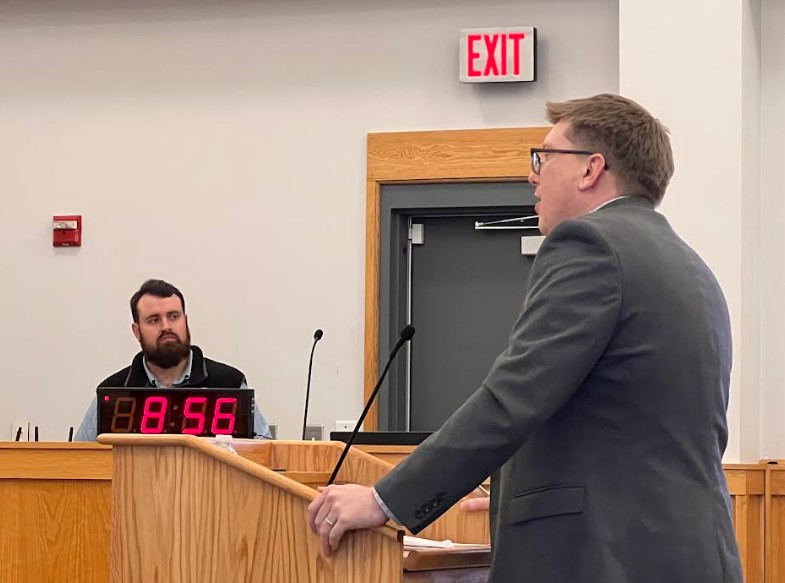
SMITHFIELD — After a nearly three-hour public hearing before a standing-room-only crowd, the Smithfield Town Council voted 5-2 on Feb. 17 to deny a revised proposal for the Bellamy subdivision, a large residential development that would have brought more than 1,000 homes to the town’s extraterritorial area near Wilson’s Mills.
Council members Roger Wood and John Dunn voted against the denial.
The proposal from Rock Tower Partners LLC sought conditional rezoning and voluntary annexation approval for a development planned on approximately 500 acres along Wilson’s Mills Road and Lee-Youngblood Road. The updated plan reduced the project to 1,076 homes — 71 fewer units than the previous version rejected in October 2025 — and included new concessions intended to address earlier concerns.
Among those changes were expanded buffers near neighboring properties, increased open space, additional parking requirements, and an offer to donate approximately seven acres of land along Lee-Youngblood Road for a potential future fire station, EMS facility or water tower.
Despite the revisions, the council ultimately determined that key concerns remained unresolved — particularly the subdivision’s proximity to a long-established hog farming operation and its compatibility with surrounding rural land uses.
Hog farm proximity dominates debate
Much of the discussion centered on the nearby hog farm, which attorney Andrew Petesch of Raleigh said has operated for decades and produces between 11,000 and 12,000 hogs annually.
The revised plan increased the setback between the development and the agricultural operation from 200 feet in the original proposal to 500 feet. However, some council members said the distance still fell short.
Mayor Pro Tem Sloan Stevens said a significantly larger buffer would have changed the conversation. “Something closer to a 1,500-foot buffer and this would be a different conversation,” Stevens said.
North Carolina law requires new hog farms to maintain at least a 1,500-foot setback from existing residential developments under state agricultural regulations, including provisions in N.C. General Statute 106-803. However, there is no comparable state law governing how close new residential development may be built to existing hog operations — a regulatory gap that became a central point of debate during the hearing.
Councilman Travis Scott expressed concern about odor impacts and whether future residents would fully understand the realities of living near an active agricultural operation.
Developers said they planned to include disclosure language in homeowners association documents notifying buyers about the nearby hog farm. Scott questioned whether that would adequately inform renters.
Scott said there will likely be rental homes in the subdivision and questioned how renters would be made aware of the farming operation.
Stevens added that the project could represent one of the largest residential developments in North Carolina proposed so close to an existing hog farm.
Petesch, the attorney for the hog farm operators, argued the farm’s long-standing presence should carry significant weight, noting that Bellamy’s primary park and pool would be located within approximately 1,800 feet of the operation.
Density reductions and proposed concessions
Planning documents show the revised Bellamy plan included a density of about 2.2 homes per acre and incorporated multiple design adjustments, including increased landscape buffers ranging from 20 feet to as much as 500 feet in some areas and a commitment to construct the phase closest to the hog farm last.
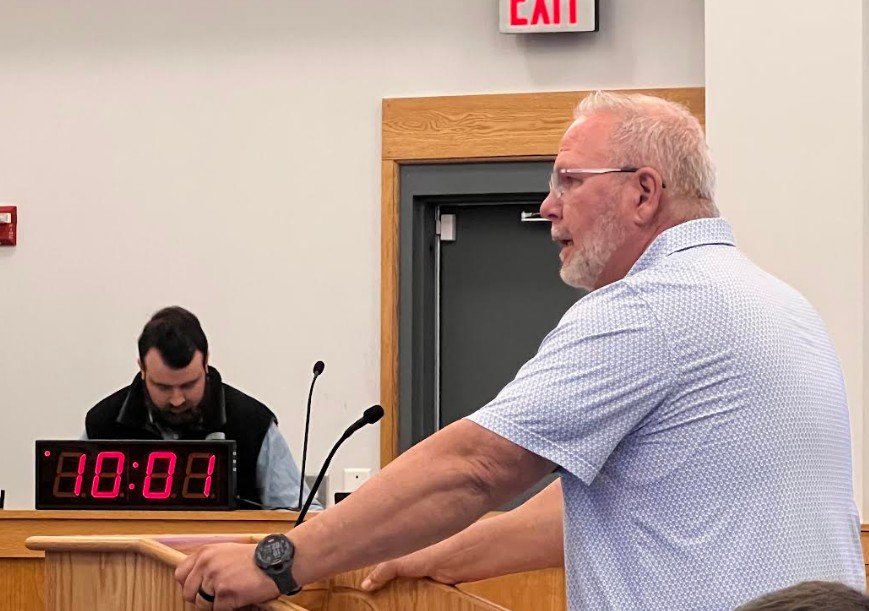
Developers also proposed more than 135 acres of passive open space, nine pocket parks and a central amenity area with a pool and clubhouse.
Petesch criticized the proposal, arguing that while it sought R-8 conditional zoning approval, numerous variances — including reduced lot sizes, setbacks and right-of-way widths — effectively made it resemble higher-density R-6 zoning.
He also warned the subdivision could generate more than 10,000 daily vehicle trips along Wilson’s Mills Road, which he said was not designed to handle that level of traffic.
Regional concerns raised by Wilson’s Mills officials
Officials from neighboring Wilson’s Mills also weighed in, emphasizing jurisdictional and planning challenges. A portion of the property lies within Wilson’s Mills’ extraterritorial jurisdiction and is closer to that town’s limits than to Smithfield’s.
Wilson’s Mills Planning Director Wendy Oldham and Assistant Planning Director Marvin Parrish said the development could be “a wonderful neighborhood,” but not in the proposed location.
Oldham said Wilson’s Mills is not currently pursuing additional residential growth, noting that six major subdivisions already approved in recent years are expected to add roughly 5,000 homes when fully built out.
Dodd questioned how many jobs the subdivision would create once construction had been completed. “We want people to work here, not just live and sleep here,” Dodd said.
Property rights and legal arguments
During council deliberations, Council members Roger Wood and John Dunn both expressed concern about property rights implications.
Wood said denying the project could be unfair to developers.
“I don’t know if you can put anything there to satisfy the Youngbloods,” Wood said after the vote.
Dunn said requiring a 1,500-foot buffer could infringe on the developer’s property rights.
Former Johnston County 911 director and retired Smithfield firefighter Brett Renfrow urged council members to consider long-term impacts.
“Smithfield needs managed growth,” Renfrow said. “The decision the town council makes will impact the entire town going forward.”
Developers warn of alternative plan
An attorney representing the developer said the property would ultimately be developed regardless of the council’s decision, displaying a conceptual map of a smaller subdivision that could be built by right under the current R-20 zoning without council approval.
He said denying annexation could cost Smithfield approximately $3 million annually in potential ad valorem tax revenue.
Petesch criticized the argument.
“Now they say if you don’t do this we will do a spite subdivision,” he said.
Councilman Dr. Gettys Cohen said the map raised new questions.
“This document has opened up a can of worms,” Cohen said.
Annexation request withdrawn
Following the 5-2 vote to deny conditional rezoning, the developer withdrew a separate request for voluntary annexation of the property into Smithfield’s town limits.
The decision marks the second time the Bellamy project has been rejected, leaving its future uncertain as debate continues over how Smithfield should balance growth, infrastructure capacity and compatibility with longstanding agricultural operations.
Subscribe to get the latest posts sent to your email.










This was a smart decision from the city council, these developers do not care about the quality of living for these families after they purchase their home. They just want to make money by selling them one. Imagine how miserable it would be to live that close to a hog farm, the smell alone would be unbearable.