




County commissioner profits from property sale, says transaction followed all legal requirements
SMITHFIELD, N.C. — A recent land purchase by the Smithfield Town Council is drawing scrutiny for possible violations of North Carolina’s Open Meetings Law and concerns about conflicts of interest. The purchase was approved without a public vote and did not come to light until the deed was recorded with the Johnston County Register of Deeds.
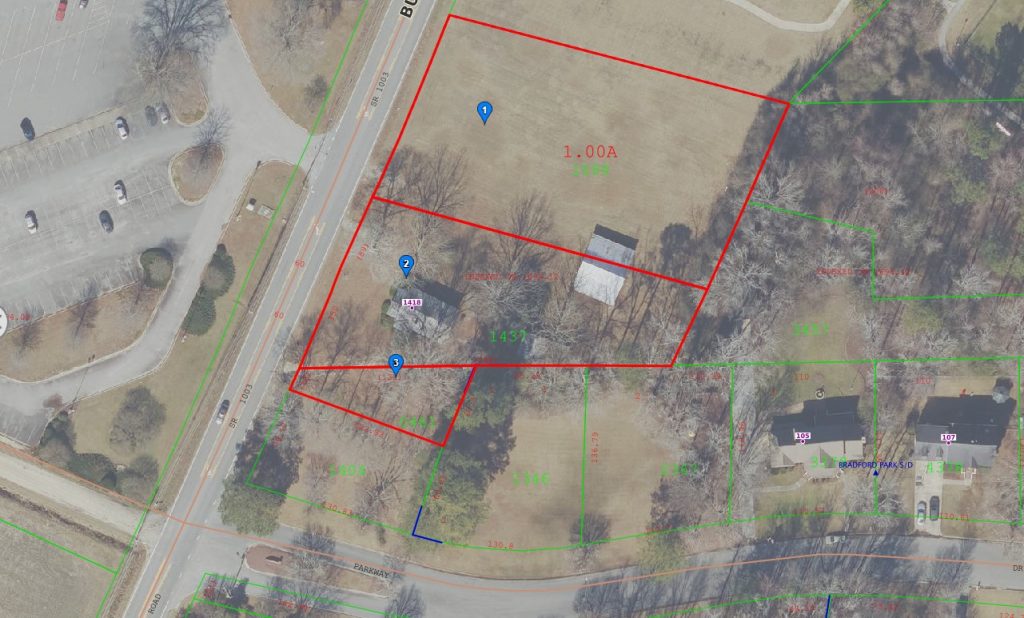
According to public records, the town closed on March 5, 2026 for three tracts of land in the 1400 block of Buffalo Road totaling about 1.7 acres for $350,000. Johnston County tax records list the parcels at a combined assessed value of $259,460, meaning the town paid roughly 35% above tax value. The property had been listed in 2023 for $215,000 — about 63% less than the amount the town ultimately paid.
The timing and secrecy of the purchase have alarmed residents. The property was listed by April Stephens, who also serves as a Johnston County commissioner and voted in favor of $2 million in funding for the Smithfield Tobs baseball stadium project. On Nov. 18, 2025 the town council approved a contract with the Smithfield Tobs. Stephens, a licensed real estate agent, listed the property for sale on Dec. 23, 2025, and the property went under contract Jan. 23, 2026, before being purchased by the town on March 5, 2026.
Closed Sessions and Town Manager Comments
In an email, Interim Town Manager Kimberly Pickett confirmed the property acquisition was discussed during closed sessions on Jan. 6 and Jan. 20 under state statute governing real estate negotiations.
“The purchase of 1418 Buffalo Rd was discussed in closed sessions on January 6 and again on January 20 under G.S. 143-318.11(a)(5),” Pickett said. “This statute does allow for informal consent to be held during closed session. Unfortunately, both those sessions have not been released to the public yet.”
Pickett said the town plans to place a resolution on the April 7 consent agenda to formally acknowledge the purchase in open session. (A consent agenda is a group of routine, non-controversial items that a governing board typically approves in a single vote, without discussion during open session.) She also noted the closing has already become public record through courthouse filings.
“The closing, however, has been made public in records at the courthouse,” she said.
Smithfield Town Attorney Bob Spence acknowledged the public record status of the purchase. “Basically, as you can see from the registry the town recorded this publicly. The town has hundreds of real estate transactions recorded and most are never announced. There are too many…”
“We do not have any interest in not being transparent,” Spence said.
He added that ongoing negotiations sometimes require discretion.
Legal questions about process
The assertions by the interim town manager and town attorney that the land purchase complied with public records law may be inaccurate. North Carolina’s Open Meetings Law generally requires that final actions by public bodies, including property acquisitions, be conducted in open session, even if preliminary negotiations occur privately.
Kristina M. Wilson, assistant professor of public law and government at the UNC School of Government, said the statute cited by the Town of Smithfield allows closed sessions for negotiating real estate transactions — but not necessarily for final approval.
“The default rule under G.S. 143-318.11(a)(5) is that a final approval of a property purchase contract should occur in open session,” Wilson said. “Since the statute is limited to negotiating the contract, I believe final approval — once negotiations are complete — should be done in open session.”
Wilson added that if a board does take a final vote in closed session, the issue can be corrected.
“A perhaps improper closed session vote is only a problem until the board ratifies their action in open session,” she said. “At that point, the defect is cured, and there is no legal violation.”
Broader context on closed sessions
Guidance from the UNC School of Government indicates that while councils may meet in closed session to discuss negotiating positions, discussions must be limited to “material terms” of a contract.
Court rulings, including Boney Publishers v. Burlington City Council, have further clarified that certain information — such as property location or purpose — may need to be disclosed in open session unless it is directly tied to negotiation strategy. Legal experts also note that site selection decisions typically must occur in open session unless they are themselves a material part of negotiations.
Property Listing by County Commissioner: “I understand how this could raise questions…”

Online real estate records show the Buffalo Road property purchased by the town was listed by April Stephens. Stephens also serves as a Johnston County commissioner.
Last year, county commissioners, including Stephens, approved $2 million in funding for the Smithfield Tobs baseball stadium project.
The Johnston County Report emailed Stephens on March 20 seeking comment about her role in the transaction. Stephens responded on March 27.
“I appreciate the opportunity to address these questions. Transparency and public trust are very important to me, both as a County Commissioner and in my real estate career. I want to be clear that everything related to this transaction was handled ethically, legally, and in accordance with all professional standards. I understand how this could raise questions, but from my perspective, there was no actual conflict. I am always mindful to keep my responsibilities as a Commissioner and my role in real estate separate. That said, I do recognize that perception matters.”
“Additionally, the Smithfield baseball project was voted on in early October (by commissioners). I and my associate Cassidy Stickl were contacted to sell the Buffalo Road property and entered into an agreement on December 9, 2025. I had no knowledge of the future sale of the property during the discussions of the potential TOBS relocation. Additionally my associate Cassidy Stickl managed the transaction and negotiations with the town’s buyer broker… I as well as my associate Cassidy received a standard commission as part of the transaction and I am willing to disclose that through the appropriate channels if requested. Based on the timing and information available, I do not believe discussion or recusal was necessary. I had no vote or influence regarding the town’s negotiations or vote. There were no inappropriate or concerning discussions with town officials prior to the listing or any related decisions. I spoke with the planning department at the Town prior to listing the property to help determine permitted uses and potential future uses to assist in our marketing. I care deeply about this community and am always open to conversations that strengthen transparency and trust moving forward.”
Land Use and Concerns
Pickett said the 1.7 acres would not be used for the baseball stadium.
“Currently, [it is] open space and a buffer for the neighborhood next to the community park. There is a possibility that we could expand parking at a later date, but a final determination has not been made at this time,” Pickett said.
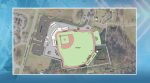
However, an initial conceptual drawing obtained by The Johnston County Report shows an indoor practice facility and clubhouse proposed for the site. The two structures are not included in the town’s existing $6 million stadium plan. Whether they will be built on the site is unknown, Councilman Travis Scott said.
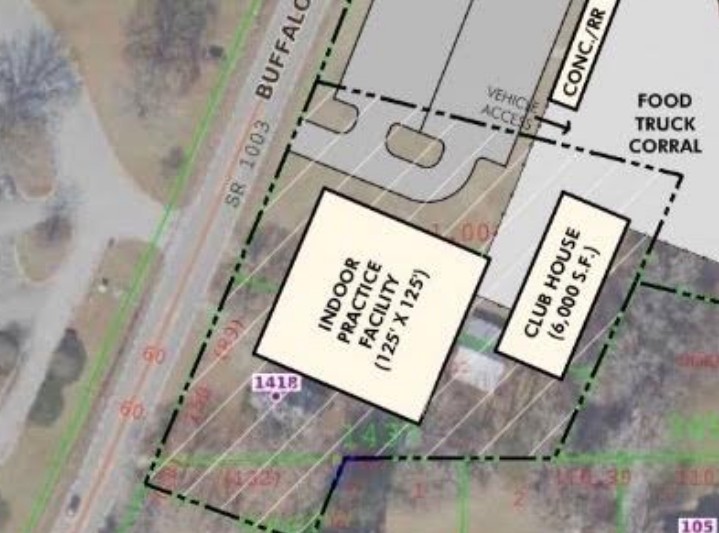
Councilman Scott has raised concerns about the location and true cost of the baseball stadium. “I am concerned about the purchase of the property with the close proximity to the (Bradford Park) neighborhood with what appears to be placing commercial structures on it without proper zoning.”
Resident Criticism
Bradford Park resident Rick Buckner expressed concern over both the price and Stephens’ involvement. “I was initially surprised to see it listed at $500,000. Given its size, condition, and lack of livability — especially when compared to a nearby property on Buffalo Road listed at $175,000 that, while in need of work, is still livable — the pricing was difficult to justify,” Buckner said. He added that the town’s eventual purchase price of $350,000 “appears to be significantly above market value for what is essentially a teardown.”
Buckner also criticized Stephens’ dual role. “This overlap raises serious concerns. The sequence of events — supporting public funding for the stadium while simultaneously listing a related property at an inflated price — undermines confidence in the integrity of the process. Equally concerning is the manner in which the Town Council reportedly approved this transaction in a closed session, limiting public visibility and accountability. This lack of transparency reinforces the perception that decisions are being made without proper public oversight, particularly when taxpayer funds are involved. This raises serious ethical questions and calls for greater transparency and accountability moving forward.”
Next Steps
Town officials have indicated the April 7 meeting will include a resolution related to the purchase, which could serve to formally ratify the land purchase transaction in open session.
Transparency Concerns
The Buffalo Road land purchase, combined with the ongoing $6 million Community Park stadium project, has intensified concerns over transparency in Smithfield government. Residents are questioning whether closed-session votes and limited public disclosure are being used to fast-track decisions that carry significant financial and community impact. Councilman Travis Scott has repeatedly called for public hearings on the stadium, highlighting issues such as demolition of existing park amenities, potential grant repayment obligations, and the broader costs of relocating public facilities. The land purchase, in which a sitting county commissioner served as listing agent, has only amplified worries that the public is being left out of key decisions.
The timing of these actions, the Town purchasing the land at a price above tax value in closed session, and the ongoing stadium preparations without full public input—raises questions about whether Smithfield is following not just the letter of North Carolina’s Open Meetings Law, but also its spirit.
Subscribe to get the latest posts sent to your email.







As usual, the town council appears more focused on looking after themselves and the interests of their well-connected allies. They don’t seem eager for the public to see where the money is going, especially when there are more pressing issues like rising utility costs and the condition of our roads. Instead of addressing these real problems, they seem more interested in spending in ways that benefit their donors. It’s disappointing to see both our town and county governments failing to put the community first. This isn’t a left-versus-right issue anymore—it feels like the government is working against the very people it’s supposed to serve.
Crooks.
Ty for exposing these ******! How do we sue to stop it
so basically the town bought a property for more than it’s listed and the agent who listed it. April Stevens is a county commissioner? Seems to me like she would’ve got a commission for the sale. I’m sorry, but the town of Smithfield is run by ****** people. Between this and the ridiculous baseball stadium these idiots don’t know what they’re doing, and anybody who trusts them needs their head examined.
Voters need to remember this closed door sessions on all this money spending the next election period. Might need some different folks holding these seats.
I hope they dont build this park i live near this and there traffic by the schools in that area are bad enough we dont need this near the schools..