




No Rate Hike Approved, But Smithfield Study Recommends Five Years Of Increases
SMITHFIELD, N.C. – A consultant hired by the Town of Smithfield is recommending a series of electric rate increases that, if eventually adopted as modeled, would raise the electric system’s rate revenues by approximately 12.6 percent over the next five years.
No electric rate increase was approved Tuesday night.
The Smithfield Town Council received the Electric Cost of Service Study and Financial Projection during its Sept. 1 meeting from Mike Johnson, rates manager with Utility Financial Solutions, LLC.
The presentation was for information only. Any future change to Smithfield’s electric rates would have to return to the Town Council for vote.
As a member of the N.C. Eastern Municipal Power Agency, the town is also required by state law to hold a public hearing before revising electric rates, fees or charges.
Five Years Of Recommended Increases
The long-range financial plan calls for overall rate revenue increases of 2 percent in fiscal year 2027, 2 percent in 2028, 2 percent in 2029, 3 percent in 2030 and another 3 percent in 2031.
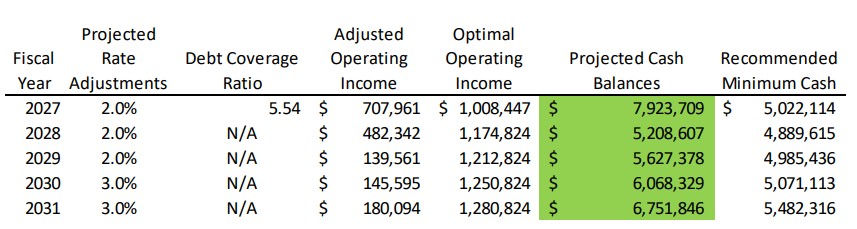
Those annual increases add up to 12 percentage points. Because each year’s increase would build on the previous year’s rates, the cumulative increase over the five-year period would be approximately 12.6 percent if all five adjustments were implemented as modeled.
That does not, however, mean every Smithfield electric customer’s bill would automatically increase 12.6 percent.
The five-year table deals with the amount of revenue the electric system is projected to need overall. A separate draft rate design distributes increases differently among residential, commercial, municipal and large-use customers.
Residential Rates
For traditional residential customers, UFS proposes gradually shifting more of the electric bill into the fixed monthly facilities charge.
The current single-phase residential base charge is $13 per month. Under the draft, it would increase to $16 in the first year, $17.50 in the second year and $19 in the third year.
The energy rate would remain essentially unchanged during the first year before increasing in years two and three.
For a residential customer using approximately 1,050 kilowatt-hours per month, the draft estimates the monthly bill would increase about $2.98 in the first year, another $3.05 in the second year and another $3.13 in the third year.
That would put the monthly bill for that amount of electricity roughly $9.16 higher after three years than under today’s rates, assuming usage remained the same.
UFS calculated that Smithfield’s current $13 residential customer base charge is below the estimated $19.54 actual cost. The consultant recommends moving toward those fixed costs gradually rather than making the entire adjustment at once.
Cash Reserves Drive Recommendation
The principal concern identified in the study is what happens to Smithfield’s Electric Fund if rates remain unchanged while expenses continue to rise.
Without rate adjustments, UFS projects operating income will turn negative beginning in 2028.
Cash reserves would also fall sharply.
The study projects the Electric Fund would have approximately $7.57 million in cash at the end of fiscal year 2027 without rate increases. That balance is projected to fall to $4.14 million in 2028, $3.45 million in 2029, $2.21 million in 2030 and just $615,011 by 2031.
UFS recommends Smithfield maintain approximately $5 million or more in cash reserves during the projection period. The recommended minimum for 2031 is approximately $5.48 million.
Under the consultant’s recommended series of 2 and 3 percent annual revenue increases, the Electric Fund is instead projected to finish 2031 with approximately $6.75 million in cash, above the recommended minimum.
The study does contain some positive findings about the utility’s financial condition. Smithfield’s electric system is expected to be debt-free by the end of 2027, and its infrastructure was found to be within or slightly better than the average range for system age.
For now, Smithfield’s existing electric rates remain unchanged.
The Sept. 1 presentation gives council members a financial roadmap for what UFS believes will be needed through 2031. Any actual rate increase, including the amount and how it would be divided among customers, would require future action by the Smithfield Town Council.
Subscribe to get the latest posts sent to your email.

Comments are closed.







They studied the new TOB’s ball field budget and recommended an electric rate increase.
They haven’t studied the right folks. Its a 19.7 minimal, guaranteed.
Be blessed.
Here’s an idea don’t build a stupid ball stadium and keep our rates the same!!!
Nobody, and I mean NOBODY who is a native Johnstonian, gives 2 hoots about the “tobs”! (Still the dumbest name for a sports team!) How about we save the 30+ million dollars it’s ultimately going to cost our taxpayers for that monstrosity, and use a little bit of that amount it to fund budget shortfalls and a little more to create a center-turn lane on Market Street through downtown?? I’m sure there are other things more pertinent than the whole stadium nonsense. Seems like a no-brainer to people who have a little common freaking sense!!
None of the “ElectiCities” towns should be in the distribution business. It’s insane.
I think most people do not understand this. You are spot on.
Nobody wants to talk about this stupid business model they’ve locked themselves into.
Economy of scale is rarely more pertinent than this example.
BIG DITTO on Nixing that RIDICULOUS BALLFIELD IDEA!!!
How INSANE is that!
It’s all about greed. Wanting more and more and not thinking about or even trying to cover the NEEDS of the town. We need better streets, more water and sewer, more substations to provide electricity to what exists right now. We need better people running things. People who think about the people and not trying to show off by building a useless ball stadium when so much that’s needed is lacking in the town. It’s all getting down right stupid. And I thought we had highly educated people in these offices. Not one of them is using their common sense that the good Lord gave us all. I will repeat what I feel others are thinking. We don’t want or need that ball stadium!!
AWESOME – LETS GO MAGA‼️