




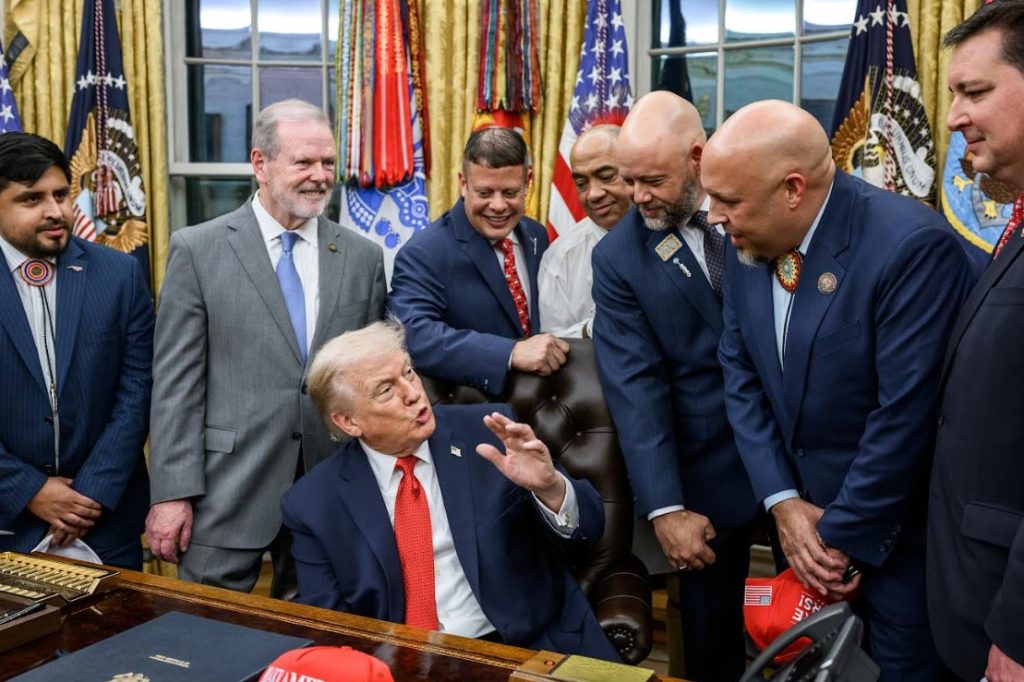
WASHINGTON, D.C. – By the time Cirilo Perez stepped into the Oval Office in December 2025, the moment carried the weight of generations. For the University of Mount Olive alumnus, it was not only a professional milestone but a deeply personal one, shaped by years of focused work and commitment to the Lumbee Tribe of North Carolina.
Perez’s path to that historic day began far from Washington, D.C., rooted in the soil and values of eastern North Carolina. Born in Sampson County and raised in Johnston County, Perez credits his upbringing with shaping the person he is today. His parents, he says, made sacrifices that laid the groundwork for every opportunity that followed.
“My parents sacrificed to create opportunities for me, and they instilled the values that became my foundation,” Those lessons in work ethic, humility, discipline, and perseverance carried Perez from the classroom to the track, and through long summer days working on the farm.
“I was able to easily transfer those values into everything I did,” Perez said. “They became my compass.”
As his senior year of high school approached, Perez began searching for a college that could offer both academic rigor and the chance to continue competing in track and cross country. A conversation with a friend already attending Mount Olive proved pivotal. An official visit soon followed.
“After that visit, I knew the University provided everything I was looking for,” Perez said. “Strong academics, competitive athletics, and a family atmosphere.”
As the first person in his family to attend college, he arrived on campus in August 2012 with plenty of questions. He found a support system ready to help him navigate unfamiliar territory both in the classroom and as a student athlete on the Cross-Country team.
Inside the classroom, Perez was challenged to analyze ideas and engage in thoughtful discussion. Professor Glenn Coffey pushed him to analyze real-world scenarios rather than rely solely on theory.
“Anyone who’s taken his classes knows you have to be prepared to think and speak up,” Perez said. “He emphasized dialogue and real-life applications, and that stuck with me.”
Those experiences proved invaluable as Perez entered a profession built on communication and policy analysis.
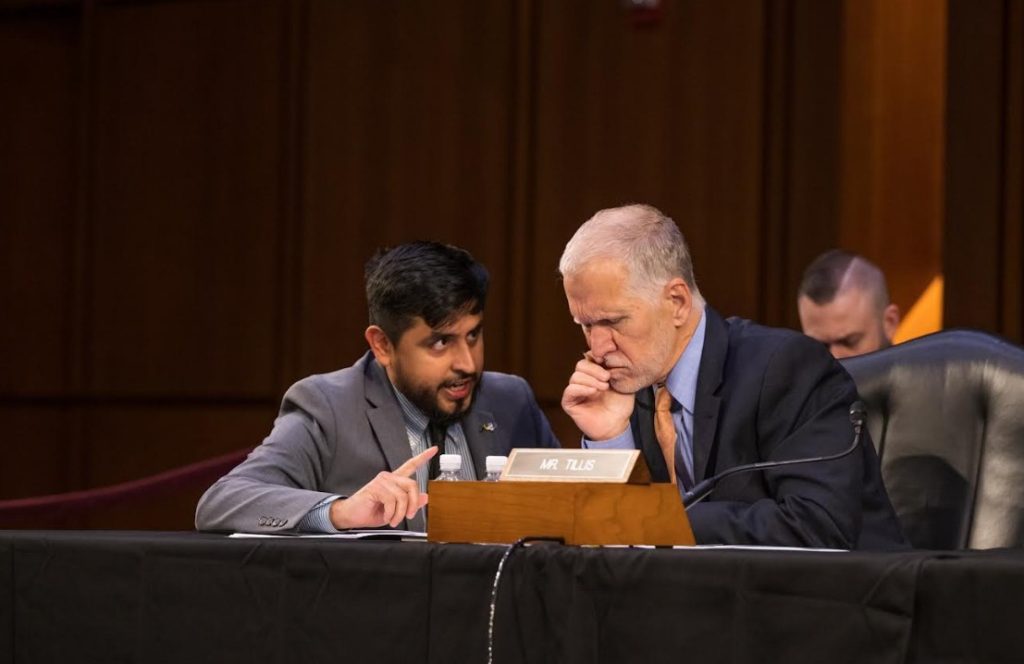
Perez graduated from UMO in 2016 with a bachelor’s degree in criminal justice and criminology. He went on to gain experience through internships with local government offices and completed a master’s degree at ECU. A colleague later alerted him to an entry-level opening in the Washington, D.C. office of U.S. Senator Thom Tillis.
Perez applied, interviewed, and was offered the position.
He joined Senator Tillis’s staff in March 2019 and today serves as Senior Professional Staff. His responsibilities include communicating the senator’s positions on legislation to constituents and other offices, as well as managing part of the senator’s judiciary portfolio, where his criminal justice background is put to daily use.
“A lot of what I learned at UMO comes into play,” Perez said. “You have to understand policy, think with discipline, and explain complex issues with clarity. Those skills were built in the classroom.”
In December 2022, Perez was assigned to work on legislation seeking full federal recognition for the Lumbee Tribe of North Carolina. At the time, tribal policy was unfamiliar territory.
“I was a bit puzzled,” he admitted. “I had never worked on tribal policy before.”
Perez approached the assignment as a student, immersing himself in the history of Lumbee recognition. He spent months reviewing Congressional Library resources, historic testimonies, and reports. He leaned heavily on Lumbee leadership, former Congressional staff, academics, and Native American organizations from across the country.
The work was complex and often challenging. Perez and Senator Tillis quickly discovered that a small, but persistent opposition group had long influenced perceptions of the issue on Capitol Hill. For years, many Senate offices had heard only one side of the story.
The strategy shifted toward education and relationship-building. Perez worked at the staff level while Senator Tillis directly engaged his colleagues, addressing concerns with carefully compiled research and firsthand accounts. Over time, momentum grew. Support poured in from 240 federally recognized tribes, along with backing from both President Donald Trump and former President Joe Biden.
After more than a century of advocacy by the Lumbee people, progress finally accelerated. Senator Tillis identified the National Defense Authorization Act as a viable legislative vehicle, following precedent used for other tribes. Months of negotiations followed among the House, Senate, and White House.
On December 10, 2025, the House passed the NDAA with the Lumbee Fairness Act included. The Senate approved it on December 17, and it was signed into law the very next day.
For Perez, the moment was both professional and profoundly human.
“Knowing the history and how long the Lumbee people had waited made it incredibly meaningful,” he said.
Perez attended the signing ceremony in the Oval Office, alongside Lumbee Tribal Chairman John Lowery and other Lumbee members. Meeting President Trump and witnessing the bill’s signing was, he said, “surreal and humbling.”
“Being in such a historic place made the moment feel even more significant,” Perez said. “President Trump was gracious, and the fact that Lumbee leadership could be there made it something I’ll never forget.”
Attendees received a presidential challenge coin and a White House signing pen, keepsakes from a day that will remain etched in Perez’s memory.
From his eastern North Carolina roots to the halls of Congress, Cirilo Perez’s journey is one of quiet determination, shaped by family values, sharpened in the classrooms at UMO, and realized through public service at the highest levels of government.
For Perez, the Oval Office moment was not an ending but a reminder of why the work matters.
“It’s about serving people and honoring their stories,” he said. “That responsibility is something I carry with me every day.”
Subscribe to get the latest posts sent to your email.

Comments are closed.



Too bad he couldn’t fix Tillis. He looks like he’s struggling with the lunch menu in that photo.
TRUMP! TRUMP! TRUMP! TRUMP! 🙂
Amen!!
What does trump have to do with this individual’s upbringing and accomplishments? 🤨