By Theresa Opeka
Carolina Journal
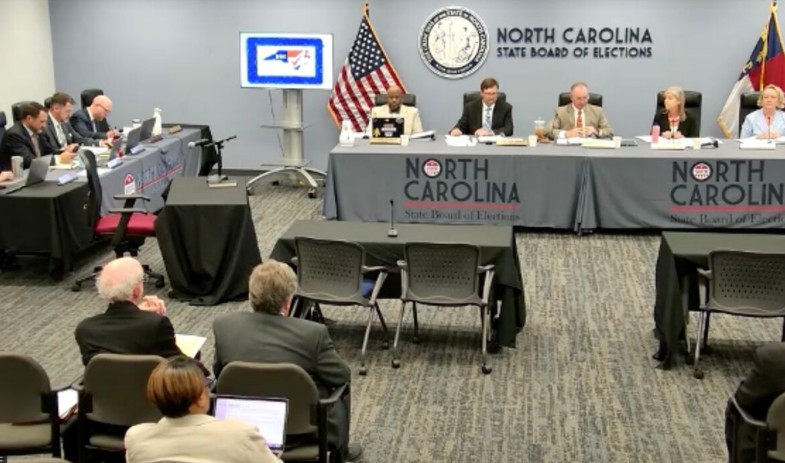
On Monday, the North Carolina State Board of Elections (NCSBE) voted 3-2 along party lines on new permanent absentee ballot rules that once again have critics concerned will make it easier for ballots to be thrown out.
Similar concerns were raised on Thursday, when the board voted on a series of voting rules, including in-person voting photo ID rules.
Adam Steele, associate general counsel for the board, said about 650 comments were received through their website, about 85 pages of email, as well as mailed, hand delivered, and at public hearings. Some changes including technical changes and tightening up of language.
Six rules were voted on at Monday’s meeting, that included four definitions, which he said clears things up with references to the rules for absentee voting. Also instead of saying “ballot envelopes,” they will use the term “container return envelopes,” a change made throughout the rules.
The second describes a review for deficiencies and adds a requirement for the county boards for staff to document whenever an absentee ballot envelope is received from the voter.
The third involves the photo ID exception form, which states the photo ID affidavit can be included with an absentee ballot. The rules proposed, Steele said, say that someone who’s assisting a voter who’s unable to sign due to their disability would sign the affidavit on their behalf, which is not in line with how guidance has been. It’s being changed to say that they need to indicate on the signature line of the affidavit that the voter is not able to sign by writing that out.
County board staff also need to document what the deficiency is, which they do by recording what the problem was in the State Elections Information Management System (SEIMS) or on the log. And if the voter is notified about a deficiency over the phone, then the county board staff need to record when that phone call was made, either by e-mail or a letter that will already be documented on paper.
The fourth deals with non-curable deficiencies. In the statute for the return of absentee ballots, Steele said it specifically says a zip code missing from the witness or assistant on the application doesn’t affect the validity of the application. Steele said he reiterated that if the voter gets notified about their ballot being spoiled and reissued by phone that staff need to document that they made the phone call and then enroll it.
The fifth mainly clarifies where a voter shows up to an early voting site or the county board office to submit their absentee ballot. It says it will be known whenever it’s not in an outer return envelope when they just show up with their container return envelope and they need to seal it right then.
The sixth deals with irregularities that require further action and how a county board should proceed with different scenarios. For example, the absentee ballot is inside the ballot container-return envelope that appears to have been opened and re-sealed, but the ballot container-return envelope is received by the county board of elections in a sealed outer return envelope.
Democrat board member Jeff Carmon said he had concerns about how the photo ID exception rule might impact the elderly who don’t have access to email and may be overwhelmed.
Steele said the rule would apply to anybody regardless of age, even if they had spotty phone service or haven’t provided a phone number.
“If the phone number or e-mail address is included, then they should be used to contact the voter, but those aren’t required to be included either by statute or by rule whenever somebody’s submitting their absentee request,” he said.
Carmon went on to say that he has significant concerns with individuals in rural North Carolina receiving notice via mail as well.
“The mail system being what it is, without knowing how the latest litigation with the president’s desires as it represents mail-in voting, how that’s going to impact us?” he said. “I just can’t support this rule. I know so many people who are elderly or otherwise not as versed at voting and completing the documents will be overwhelmed with this. And I’m afraid it’s going to chill the vote.”
Republican board member Angela Hawkins said the spoil and reissuing of a new ballot is the quickest way for a voter to get their vote cast if the ballot was not sealed for a number of reasons, with the main one being for security purposes.
Democrat Board member Siobhan Millen said she was confused as to how this will be quicker versus how it used to be done where if the ballot was not in a sealed container return envelope, they would contact the voter and if the voter said they didn’t think it had to be sealed, the ballot would be counted and the person would be done.
“Under our interpretation previously, there was no more work for the voter to do no matter how long it took the board to do their work,” she said. “There was no more work for the voter to do. Now there is work for the voter to do.”
Millen also argued that they keep changing the definition of what a container return envelope and a return envelope is and it’s confusing for the voter, making it “over fastidious” to throw a ballot out.
Hawkins said she disagreed and that the word container return envelope shows up 37 times in Chapter 163 of the state statutes and ballot envelope does not show up at all. She added that if someone has trouble understanding any of the instructions, they can contact their county board of elections or the state board, all of which would be happy to help.
Republican board member and secretary Stacey “Four” Eggers IV agreed with Hawkins that the spoil and return approach is the most accommodating to the voter and that an unsealed envelope is a security issue for the ballot and voter.
When Carmon raised concerns that both cell phones and the mail system were not reliable, Eggers commented he didn’t know what else could be done to help a voter.
“If it’s not reliable to contact voters by mail, it’s not reliable to contact them by e-mail, and it’s not reliable to contact them by phone, and they can’t follow the clear instructions that are given to them, I’m not quite sure what exactly more we can do to help a voter and access a voter to cure their information,” he said.
Carmon disagreed.
“Clear instructions to someone who’s an experienced attorney, a very accomplished attorney I’d like to add, is very different from the remainder of our population,” he said. Everyone has not been blessed with the amount of education that we have and saying that the instructions are clear I would disagree. I would say the instructions are confusing.”
Republican member and chairman Francis De Luca added his remarks before calling for a vote.
“The most secure and secret way of doing it is to vote on Election Day and then you don’t have to worry about all this other stuff, but that’s not what we are doing,” he said. “We continue to add more ways of voting, but every time we do, we add complications to the system and that what we are trying to deal with now. How do we fix things that were not done on Election Day?”
De Luca, Hawkins, and Eggers voted in favor of the revisions, with Carmon and Millen voting against. The revisions now go on to the Rules Review Commission for review.
Theresa Opeka is the Executive Branch reporter for the Carolina Journal.
Subscribe to get the latest posts sent to your email.