



By Carolina Journal Staff
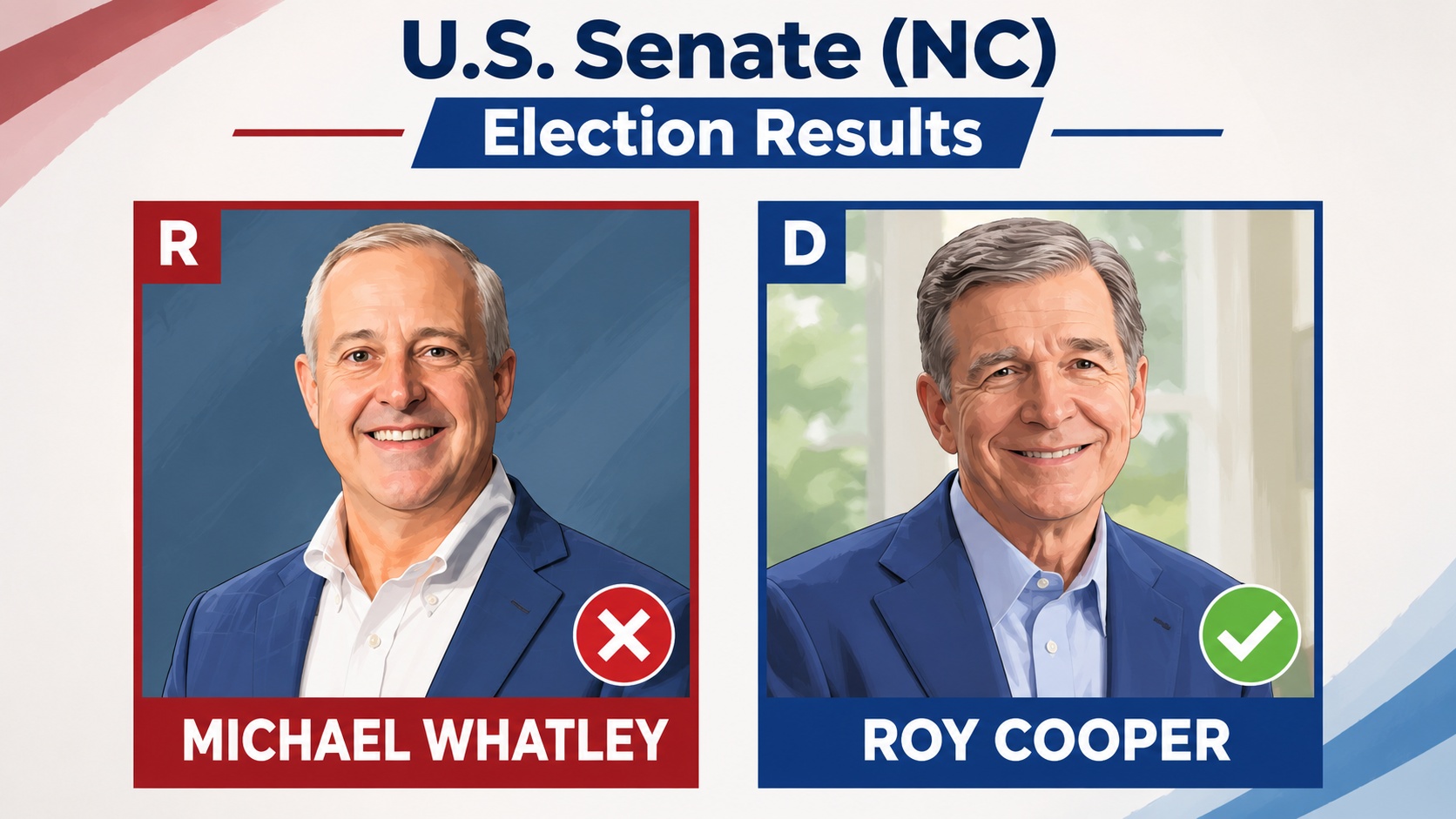
Democrat Roy Cooper has won North Carolina’s closely watched US Senate race, defeating Republican Michael Whatley and flipping a seat Republicans had held for years. Final vote numbers are not out yet, but shortly after polls closed the Associated Press called the race and Whatley has conceded, clearing the way for Cooper to represent North Carolina in the US Senate.
The victory marks a significant political shift for North Carolina and a major gain for Democrats as they seek to regain control of the US Senate.
Senate Majority PAC spokesperson Lauren French issued the following statement after Roy Cooper won the North Carolina US Senate race:
“Tonight, North Carolina voters rejected another Trump loyalist and elected a proven leader who knows how to get things done. Roy Cooper will bring the same commitment to North Carolina families to the U.S. Senate that defined his time as governor.”
Cooper, 69, enters the Senate after nearly four decades in North Carolina politics, having spent most of his career in executive offices rather than legislative leadership. His political career began in the North Carolina House of Representatives in 1987, followed by a decade in the state Senate. He was elected attorney general in 2000 and served four terms before winning the governor’s office in 2016.
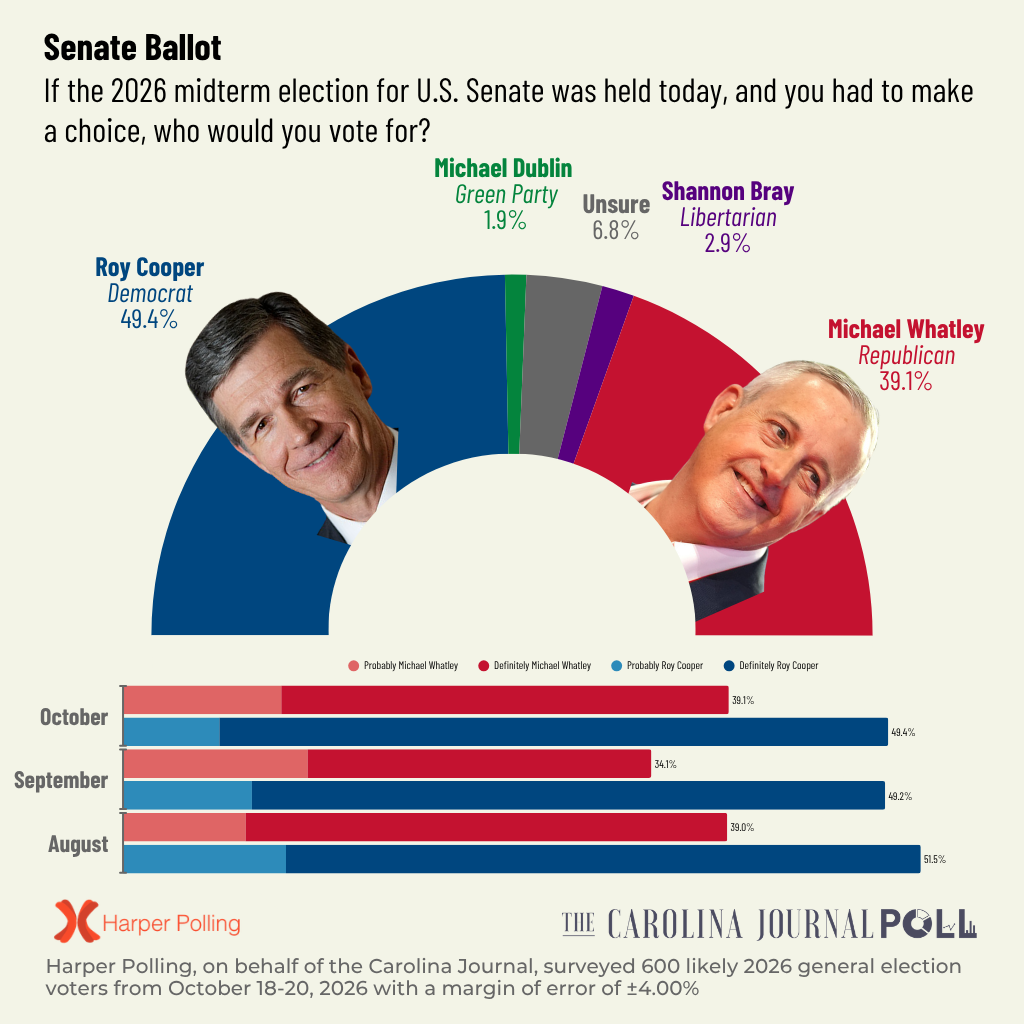
He served two terms as governor, from 2017 through 2024, making him one of the state’s most recognizable Democratic political figures and a driving force in bringing national Democratic donor dollars to the state. His experience in statewide executive office gave him a substantial name-recognition advantage over Whatley, who had never held elected office. As of Carolina Journal’s latest October poll, Cooper led by 10 points and 12% of voters still had never heard of Whatley.
During the campaign, Cooper sought to capitalize on that familiarity while presenting himself as a moderate Democrat focused on issues affecting household budgets. Inflation, the rising cost of groceries, and energy prices were central themes of his campaign.
Rather than making the race primarily about national Democratic priorities, Cooper emphasized affordability and argued that North Carolinians needed a senator focused on their economic concerns.
The September Carolina Journal Poll, however, raised questions about how voters view Cooper’s ideological positioning and what his election could mean for the direction of the Democratic Party. In that poll 60% of likely North Carolina voters believe Cooper would support the policy priorities of the Democratic Socialists of America (DSA) if elected to the Senate. That included 74% of Republicans, 54% of Democrats, and 53% of self-identified independents.
The finding presents a contrast with Cooper’s moderate campaign message. Cooper did not campaign as a democratic socialist, instead emphasizing his willingness to work across party lines, including messages about working with President Donald Trump. But the poll suggests that voters across the political spectrum anticipate he could align with the DSA organization’s policy priorities once in Washington. The October Carolina Journal Poll found that 45.9% of likely voters viewed the DSA unfavorably, compared with 24.1% who viewed the organization favorably.
Whatley, meanwhile, faced the challenge of establishing his own political identity while campaigning closely alongside President Donald Trump. A former chairman of the Republican National Committee and former chairman of the North Carolina Republican Party, Whatley had extensive experience in party leadership but no previous experience holding elected office.
Republicans sought to portray Cooper as more liberal than his campaign suggested, pointing to his record on abortion, immigration enforcement, and other policy disagreements. Concerns over low Republican voter turnout during early voting dominated Republican campaigns over the last several weeks as politicos watched for signs that Republicans would show up on Election Day to cast ballot.
“Turnout has been phenomenal,” one Alamance County Democratic poll volunteer told Carolina Journal Tuesday morning. “I’m grateful for all the voters that have been motivated to come to the polls. If the numbers are right, that means that we’re exceeding the midterm election from 2022, which is awesome. And I’m just really grateful that people are finding the time to either get out early, or what we’re seeing today, come out the day of.”
North Carolina’s US Senate race was especially consequential because it involved a Republican-held seat being vacated by Sen. Thom Tillis. Cooper’s victory gives Democrats an important pickup in their effort to regain control of the US Senate. Republicans entered the election with a 53-47 majority, meaning Democrats needed a net gain of four seats to take control.
For North Carolina, Cooper’s election represents another chapter in a political career that has spanned nearly 40 years and six successful statewide elections. His transition from governor to senator will put his governing record, legislative priorities, and ability to navigate Washington’s partisan divisions under a different kind of scrutiny.
“Roy Cooper ran a disciplined campaign as a moderate, pragmatic Democrat at a time when significant parts of the national Democratic Party have embraced a more interventionist economic agenda,” Donald Bryson, CEO of the John Locke Foundation, told Carolina Journal. “He made affordability the centerpiece of his campaign, expressed skepticism of tariffs and consistently presented himself as someone willing to work across party lines. That was an effective political message in this environment.
“The question now is whether that moderate rhetoric is reflected in his record as a US senator,” he added. “North Carolinians will be able to judge that by how he votes on tariffs, taxes, spending, regulation, energy, health care and other major economic issues. Campaigns tell voters who candidates say they are; governing records tell us who they actually are.”
Subscribe to get the latest posts sent to your email.




Lol.. so be it.. those people are about to find out a lot!!!