



By David N Bass
Carolina Journal
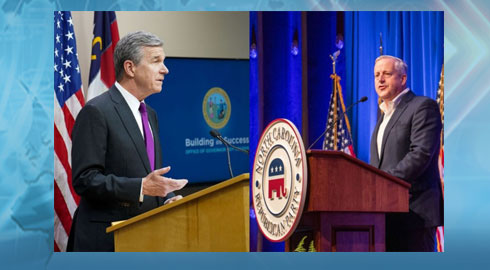
RALEIGH, N.C. – Former Democratic Gov. Roy Cooper has widened his lead over Republican Michael Whatley in North Carolina’s open US Senate race, according to the latest Carolina Journal poll of likely voters.
Cooper now leads Whatley 50% to 39%, an 11-point advantage and a widened lead from the 8-point margin Cooper held in CJ’s March post-primary survey. Four percent of voters said they would back another candidate, while 8% remain undecided.
The poll showed that Whatley continues to lag on name recognition and favorability. Cooper, a two-term former governor who has been on a statewide ballot for decades, was viewed favorably by 50% of voters and unfavorably by 39%, roughly unchanged from the last CJ poll. Whatley, the former chairman of both the Republican National Committee and state GOP, was viewed favorably by 25%, unfavorably by 22%, and 19% had no opinion. The largest group, at 33% of likely voters, said they had never heard of him.
“Roy Cooper’s double-digit lead over Michael Whatley is real — but it’s not just a generic midterm backlash,” said Donald Bryson, CEO of the John Locke Foundation and publisher of Carolina Journal. “Cooper’s 24 years of statewide name recognition is a massive advantage that no challenger can easily overcome. At the same time, Republicans are fighting headwinds: President Trump’s approval is underwater, while a majority of North Carolinians say the country is on the wrong track. That combination makes this Senate race even more difficult for the party in the White House.”
GOP faces political headwinds
The Senate numbers track a broader political environment that is trending against Republicans since the spring. Fifty-eight percent of likely voters now say the country is headed in the wrong direction — up 2 points since March — while 39% say it is on the right track. Views of North Carolina have soured more sharply: 54% say the state is on the wrong track, a 7-point increase since March, compared to 34% who say right direction.
President Donald Trump’s job approval among North Carolina likely voters has slipped to 42% approve and 57% disapprove, down from 45% approve and 54% disapprove in March. Fifteen percent of Republicans disapprove of the job Trump is doing. Democratic Gov. Josh Stein has held steady at 50% approve and 32% disapprove, with 17% of Democrats disapproving of his performance.
Democrats also hold the edge on the generic ballot. For state legislative seats, voters preferred a Democratic candidate over a Republican 48% to 41%, with independents breaking for Democrats by a net 18 points. For congressional races, the generic ballot stands at 48% Democrat to 44% Republican, unchanged since March, with independents favoring Democrats by 13 points.
In the race for state Supreme Court, Democrat Anita Earls continues to lead Republican Sarah Stevens, 41% to 36%. Five percent of voters picked another candidate and 19% remain unsure.
Cost of living tops voter concerns
When asked about the issues driving their vote, North Carolina voters again pointed to economic concerns. Inflation and the cost of living topped the list at 46%, followed by the economy and jobs at 18% and Social Security and Medicare at 17%. Republicans also put immigration and national security high on their list of concerns.
That cost-of-living anxiety surfaced in voter views on state tax policy. Asked whether North Carolina should adopt a constitutional amendment limiting how fast property tax collections can rise, a one-year moratorium on property revaluations, or both, 79% of voters supported at least one of the two options. That total included 43% who said the state should pursue both, 31% who preferred only the constitutional amendment, and 5% who preferred only the moratorium. Twenty-one percent were unsure.
“The recent announcement from the General Assembly’s leadership advancing a constitutional levy limit is an astute move for property tax reform and likely to win on the November ballot,” Bryson said. “Our polling shows that is exactly the call voters want — North Carolinians overwhelmingly support a constitutional amendment to limit future property tax increases.”
Voters also signaled a clear preference for a lean-government approach to economic competitiveness. Sixty-two percent said North Carolina should focus on keeping taxes low, reducing red tape, and expanding economic opportunity to keep the state affordable and competitive. Just 21% said the state should focus on increasing investment.
Asked separately about top priorities for state government, 47% picked keeping taxes low and 47% picked ending favoritism in government, followed closely by improving education at 44%.
On energy, voters were asked whether backup costs — the expense of maintaining reliable generation when intermittent sources like solar are unavailable — should be factored into cost comparisons between solar and other electricity sources. Forty-eight percent said yes, while 26% said only the direct cost of solar should be considered. Another 26% were unsure. Support for including backup costs ran strongest among urban voters.
Health care
Health care produced some of the survey’s most lopsided results. Sixty-nine percent of voters said they were concerned about Medicaid spending in the state, with concern running highest among voters 50 and older.
Asked whether the state should allow more health care providers to open facilities and offer services if they meet safety and licensing standards — a question that maps onto the ongoing debate over North Carolina’s certificate of need laws — 65% of voters said yes, 20% said no, and 15% were unsure.
An even stronger 75% of voters supported allowing advanced-practice nurses to provide more services without a sponsoring physician if they meet state requirements, with 16% opposed.
Education
On education, 65% of voters said they support North Carolina families receiving publicly funded scholarships to help students attend schools that best fit their needs, while 26% opposed and 9% were unsure. Support was particularly strong among black voters and among lower- and middle-income households.
Voters also weighed in on the May 1 teacher rally that closed schools in Wake County and several other districts: 54% said they supported the school closures, while 39% opposed, with Democrats and independents driving the supportive numbers.
Other policy questions
The poll also captured voter sentiment on several other policy questions:
The CJ Poll surveyed 600 likely general election voters statewide and was conducted May 10-11, 2026, by Harper Polling. The margin of error is plus or minus 4 percentage points.
David Bass is a senior contributor to the Carolina Journal.
Subscribe to get the latest posts sent to your email.










Making it easier to build homes by socializing the costs. Don’t fall for it.
No matter what Roy Cooper does I’ll always see him as the NC Attorney General dismissing the Duke lacrosse scandal.
Whatley needs to button his shirt and put on a tie to represent our state. Look the part you want to play! RESPECT!
Read this article “Cooper’s COVID prison releases see new scrutiny”, it’s from The Carolina Journal.
Sample from the article
According to the reports, a review of data from the North Carolina Sentencing and Policy Advisory Commission found a recidivism rate of 48% among released inmates. The New York Post reported that more than 600 released inmates were later accused or convicted of serious crimes, including violent felonies and sex offenses. The Post, identified 18 individuals who were later charged with murder after their release.
This is what Roy Cooper gave the citizens of NC. According to this article 18 people Cooper released have been charged with Murder since he released them. His wearing a Tie did not help these innocent people.