




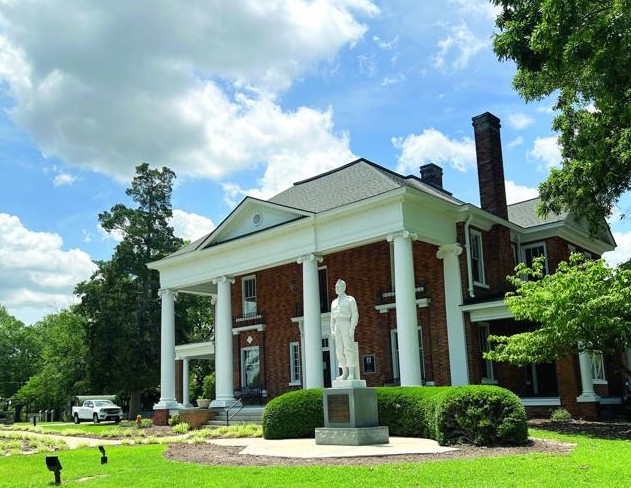
Museum to celebrate 40th anniversary June 6
By Emily Weaver
Daily Record of Dunn
DUNN, N.C. – Saturday, June 6, will be a day to remember and not just for the D-Day landings at Normandy that changed the course of World War II 82 years ago. Saturday will mark the 40th anniversary of the General William C. Lee Airborne Museum, honoring the Dunn native that made D-Day so successful.
The museum is celebrating both milestones from 10 a.m. to 4 p.m. Saturday with D-Day-themed tabletop wargames, tours of the museum and living history presentations with WWII reenactors in full uniform and period equipment. All events are free and museum officials say no experience is needed to participate in the wargames.
“There will be several historical wargames going on throughout the museum, but the main focus will be a large Airborne/D-Day scenario that can support up to 8 players and a 6 player Beach landing scenario,” museum officials noted in a Facebook post on the event. “No wargaming experience is required to play, everyone is welcome.”
Museum Coordinator Bailey Hopson said the event will feature four games, all with D-Day themes, provided by the TableTop Pathfinders Wargaming Club that started at the museum. The wargames feature battles from throughout history played out on tabletops using miniature figurines, small-scale landscapes and dice that bring history to life through strategy and luck.
“I’m looking forward to it,” Hopson said of the event.
Museum officials have been planning the day’s festivities for months as a special way to remember its founding hero and his role in the operation that marked the beginning of the end of World War II.
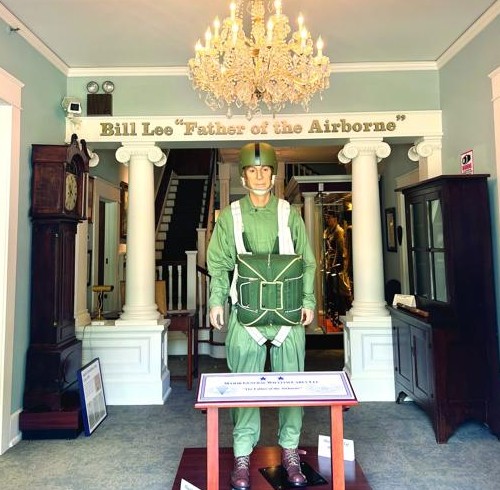
More than 80 years ago
Lee took his first steps on a long path to historic fame in Dunn, where he was born and attended school. After college, he joined the Army in 1917 and was commissioned as a second lieutenant in the infantry during World War I.
Decades later, Lee was in Germany where he got his first look at Adolf Hitler’s airborne troops in training. About a year before the Pearl Harbor attacks, he returned to Washington, D.C., with ideas on how to make America’s first troop and improve upon what he had seen. His ideas fell on deaf ears until he got a call from the president of the United States.
President Franklin D. Roosevelt had read of the German experiments and demanded that something be done. Lee was given the go-ahead to start the nation’s first troop.
“Soon, Lee was a brigadier general in command of the parachute school at Fort Benning,” The Daily Record reported in 1986. “The first thing he did was to write the military attache in Germany to secure training films of German paratroopers.
“The Germans figured it would be good propaganda to see the films out, so, for the price of $800, America found out all the Germans knew about parachuting. Lee had seen the parachute tower at the New York World’s Fair and ordered two just like it.”
Then, he trained a troop of his own and, at the age of 47, joined them as a paratrooper “because he was the sort of general who wouldn’t ask a GI to do something he wouldn’t do himself.”
“America’s airborne forces grew. Finally, the first parachute landing came in North Africa, commanded by Col. Edson Raff, one of General Lee’s prodigies. Meanwhile, General Lee was working on the over-all strategy for the invasion of Europe. …”
In a special edition commemorating the museum’s opening, Daily Record founder, the late Hoover Adams, recalled Lee’s efforts in that strategy:
“Bill Lee, sitting in a hotel room in London, wrote the airborne doctrine that was used in the successful invasion of Europe. He told (Gen. Dwight) Eisenhower and all the others how it ought to be done — how it had to be done. The doctrine he wrote was accepted by the High Command without a single change or alteration.
“When the Americans landed on D-Day, the troops were following the orders and the procedures outlined by General Lee. … An ailing heart — no doubt brought on by tireless work for his country — brought General Lee the greatest disappointment of his life. It cheated him of his greatest desire, actual participation in the invasion. He returned home and was retired with a broken heart. But his service to his country went on. The Army quickly assigned him to advisory duties,” counseling leaders on the airborne and serving on the Airborne Planning Board.
The Gen. William C. Lee Airborne Museum opened to much fanfare on June 6, 1986, almost 38 years after Lee “passed on to a world … (with) no more wars.”
The museum operates out of the home where Lee once lived with his wife at 209 W. Divine St. Its rooms are now filled with exhibits that tell the life of a local man who became a legendary hero.
Subscribe to get the latest posts sent to your email.

Comments are closed.




Sounds very interesting. A real American HERO and Patriot.