



By Andrew Pomeranz
Carolina Journal
North Carolina House Republicans have formally filed legislation to place a constitutional amendment before voters that would require limits on how much local governments can grow property tax revenues.
House Bill 1089, sponsored by Reps. Echevarria, R-Cabarrus; Howard, R-Davie; Setzer, R-Catawba; Paré, R-Wake would amend the state constitution to direct the General Assembly to enact a cap on property tax growth through a levy limit.
The bill was filed on April 30 and referred to the House Finance Committee. The bill filing follows numerous House committee meetings in recent months examining property tax trends and reform options.
Joseph Harris, fiscal policy analyst for the John Locke Foundation, said the proposal builds on broader GOP efforts to curb rising property taxes.
“House Bill 1089 is the next step in the property tax reform process,” Harris said. “While Senate Bill 889 addresses short-term concerns by delaying reappraisals, this bill begins to tackle the underlying issue by limiting how quickly property tax collections can increase.”
Unlike caps on tax rates or property values, a levy limit restricts overall revenue growth. Even as property values rise, local governments remain limited in the additional revenue they can collect.
“A well-designed limit should account for inflation and population growth so it reflects real economic conditions, and it needs to be comprehensive — otherwise local governments will find ways around it, undermining the goal of providing relief for taxpayers,” said Harris.
The proposals come as lawmakers grapple with evidence that property tax collections have grown significantly in recent years. A recent John Locke Foundation study found that property tax revenues in North Carolina’s 10 largest counties exceeded inflation plus population growth by more than $2.6 billion over the past decade. Average revenue growth was about 62%, compared to a 51% benchmark tied to inflation and population.
The gap was even more pronounced in several fast-growing counties. Wake County’s property tax collections grew by approximately 103%. Cabarrus County’s collections more than doubled during the same period. Both increases far outpaced the benchmark tied to inflation and population growth.
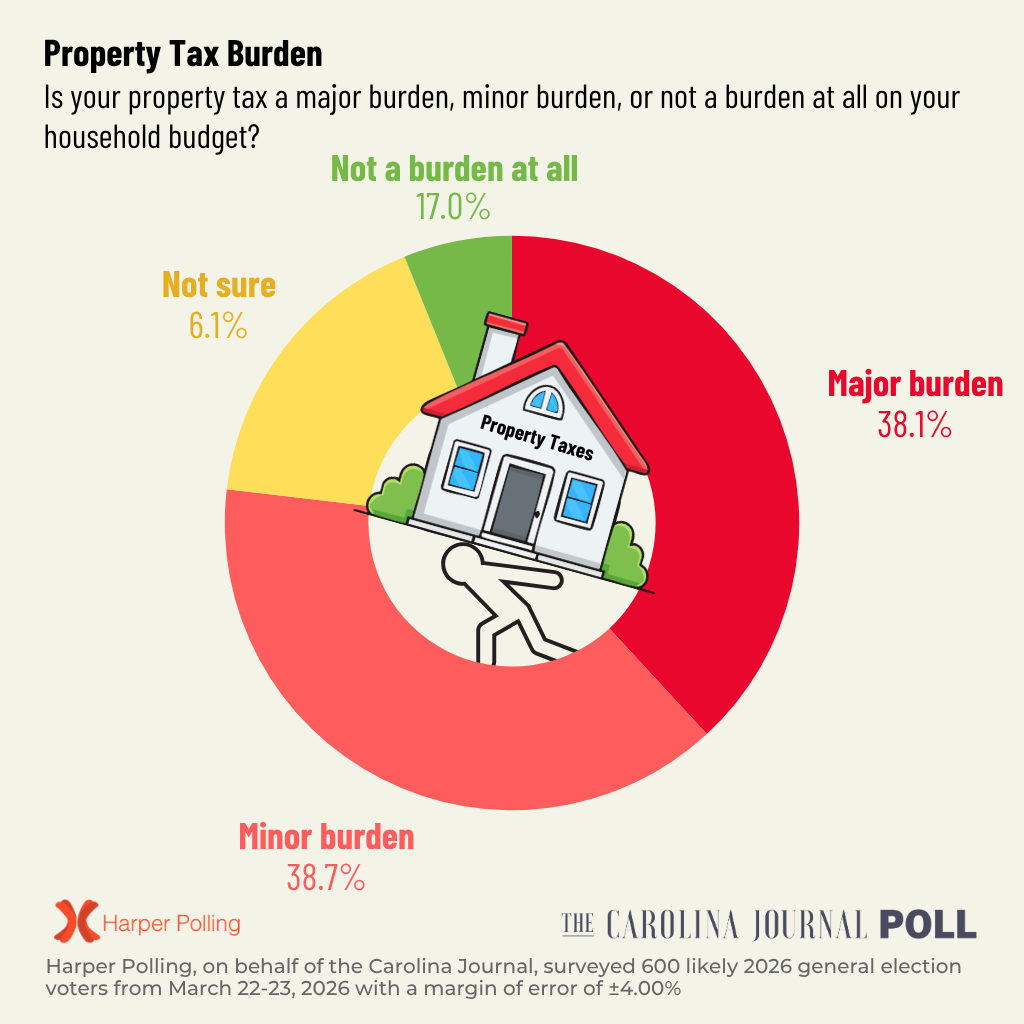
Recent polling suggests public sentiment is increasingly aligned with these concerns. A March Carolina Journal poll found that 76.8% say their property taxes are a burden on their household budget, and 73.2% would support an amendment to the North Carolina Constitution that would require limits on local government property tax increases.
Supporters say the amendment is needed to rein in rapid growth in property tax collections over the past few years. They argue a cap would provide predictability for homeowners and businesses while forcing local governments to better control spending.
Critics have raised concerns that a state-imposed cap could constrain counties’ and municipalities’ ability to fund essential services, including public schools, emergency response, and infrastructure. They also argue the amendment would shift power away from locally elected officials and toward the General Assembly.
Constitutional amendments in North Carolina require approval from three-fifths of both the House and Senate before appearing on the ballot. If HB 1089 clears that threshold, voters statewide would have the final say in 2026.
If approved by voters, the amendment would require lawmakers to enact legislation establishing the cap.
Subscribe to get the latest posts sent to your email.

Comments are closed.






I have to pat myself on the back for once again, being correct… The North moving South absolutely raises the cost of everything. They are the number 1 and only reason the property tax raised 10 folds. They cry whenever they are pointed out, but fact is, they are the ones that need pointing to!
This is surely needed and week never pass.
It’s funny how the state legislature constantly complains about Washington micromanages states and that states know what’s best for the citizens of the state. But here they go micromanaging the counties, cities and towns of NC who know what’s best for their citizens. I’m not saying taxes aren’t high and out of control. If the state legislature places some type of limit on property taxes, how will towns provide services for you? Towns will just raise the rates on water, sewer and electric (for electric cities) fees, maybe sales taxes and anything else they can charge more for to raise the funds needed to provide services needed. This amendment is just a ploy to get people out to vote because they are afraid on losing their seat in the coming election. This will not reduce the amount you pay your local government just how you pay it. If you want to have a say in what your local government charges you for taxes and service, then YOU need to participate in the meetings of your local government and let your voice be heard, and vote them out if you’re not satisfied with the result. There’s a lot of complaining, but the same people keep getting reelected.
Property tax is illegal. They are taxing you on income you have not received. The reevaluation of property is completely arbitrary and not based on anything other than the need for money. Property tax should be based on lot size and should never increase. The smaller the lot, the less the tax. The uncontrolled housing growth is the sole reason for property taxes going up, so when you hear a new subdivision being built you best believe tax is going up.
Property tax is arbitrary, on unrealized gains, no source of revenue is identified or associated whereby to fund the tax payments. therefore it becomes a force driving homeowners out of their property before any cash is available for preventing a sale on the court house steps. This fulfills the drive to force we peons to “own nothing and be happy” or else! Unchecked government will consume the total substance of its citizens unless they unite to resist taxation with willing representation. “Live not by Lies”
Absolutely correct. The increases have been insane.
Don’t you wish you could write your own pay raise whenever you need more money like the county does?
Yup,pat your self on the back!
Now go hang out your white flag, cause the North beat y’all again.
Bout time someone slows down the tax and spend crowd. They want it let them write a check, I’m tired of them stealing from me to get what they want. Government has NO MONEY only the ability to steal from those that work for it.
First, they (NC General Assembly) takes away the rights of county and local governments to charge impact fees to developers. Now they want to set limits on property taxes. Is there *ANYONE* who really thinks “Raleigh knows what’s best?” This has disaster written all over it. #voteOutIncumbents #reapWhatYouVote
Impact fees would be a great way to eliminate one excuse for raising property taxes, and make those responsible pay for the additional infrastructure. Obviously developers own the Assembly.